Thanks for the Use of the Hall - Archive

This archive contains posts from May 2007 to November 2008. More recent posts are at: http://sallitt.blogspot.com

Name:
Location: New York, New York, United States

Friday, November 21, 2008

Jean-Daniel Pollet

I have a short piece on French director Jean-Daniel Pollet, subject of a recent retrospective at Anthology Film Archives, up at the Auteurs' Notebook.

Labels:

Thursday, November 13, 2008

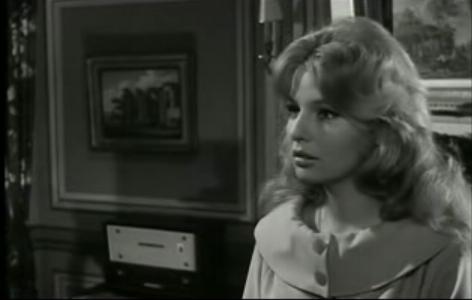
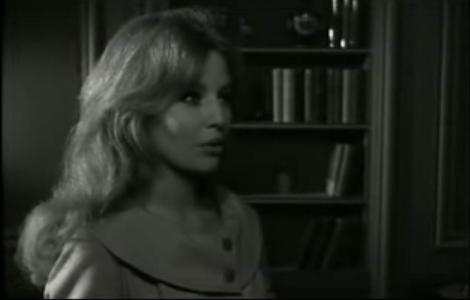
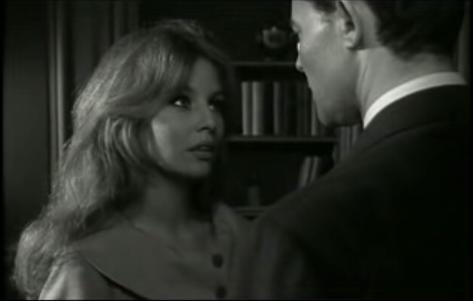
Esther Kahn: Notes on the Beloved Object

Yesterday’s screening of Esther Kahn was of the shorter cut (usually reported as 142 minutes long, though I believe it ran somewhat longer) that Desplechin created after the film’s premiere at Cannes 2000. I’d rather see the longer Cannes version (163 minutes), but the shorter one is no travesty. I don’t know of a comprehensive analysis of the differences between the versions; here are the cuts that I’ve noted.

1) Esther’s dream of a world populated by men with balloons for heads is completely excised from the short version. The dream scene is interesting, but I don’t miss it that much.
2) Philippe’s long tavern monologue about his imprisonment and subsequent mental breakdown is completely excised from the short version. Again, I can handle this loss.
3) The beautiful and mysterious scene of Esther and her father talking while crouching on the river bank is shortened. I quite regret this.
4) Esther’s negotiation with her family to work out a payment plan that will allow her to go on the stage is completely excised. I miss this scene.

I’ve written about Esther before, and so have only incremental observations to offer. What struck me most on this viewing is the streak of wild comedy that weaves through the film, and which is perhaps more obvious on repeat viewings. Esther’s quasi-autistic emotional detachment from the events of her life, though taken seriously by the filmmakers, means that her actions have a weird, willed fixity that, if you believe Henri Bergson, is intrinsically comic. And the more somber the scene, the more Esther’s automaton-like reactions are set into relief. Last night I chuckled to myself through most of the movie, and became downright mirthful at the film’s more frightening moments. To appreciate the originality of Summer Phoenix’s performance, one need only consider the scene where romantic despair makes her beat her face with her fists until it is swollen: at one unexpectedly fierce blow, her eyebrows go high in surprise, and her scientific detachment continues as she checks her jaw for major damage. A few scenes later, when Esther looks at a broken glass and does a dispassionate, silent analysis of how much damage she can inflict upon herself with it, I broke out in laughter that might reasonably have seemed inappropriate to some audience members.

It goes without saying that Desplechin’s mastery at creating ambience is a big factor in the film’s originality. But it’s interesting to think about what principles Desplechin follows – because there are all kinds of ambience, after all. In the family scenes, here and in other films, Desplechin seems to want to evoke a social paradise of intimacy and accessibility, despite (or rather because of) the film’s content pointing in a different and more uncomfortable direction. As for the evocative theater environments that dominate the last movement of the film, we experience the romance of darkened, quiet rooms (again, in counterpoint to the mounting tension of the story) and the rabbit-hutch feeling of bit players weaving in and out of dressing rooms and antechambers, all serving the purpose of the group mind that must place Esther on the stage at all costs. In Desplechin’s work, there is a backbeat – not a theme, but a vibration – of idyll, of heaven on earth, of the sum total of loved ones gathered in one place.

When one loves a film as much as I love Esther, things get confusing sometimes. My early, giddy feeling about the mystery of Phoenix’s performance - that it was impossible to tell whether she was an actress or just the right person on the right set – has passed. At a minimum, Esther has a Cockney accent, and I now know that Phoenix was raised in Florida and California. And she was compelling in the only other film I've seen her in, Henry Bean's The Believer. But it’s still exciting to watch Summer Phoenix impersonating Esther Kahn impersonating someone who might be able to do a good Hedda Gabler, and never quite to be sure which layer of the object is currently catching the light. Back in the early days of Esthermania, when Gabe Klinger said he was looking for a girlfriend like Esther Kahn, I urged him to reconsider. But I have a habit of wandering past the chic clothing boutique on Ludlow that Phoenix co-owns, hoping to catch a glimpse of her inside, even though I understand she’s in Los Angeles having babies with Casey Affleck.

Labels:

Tuesday, November 4, 2008

Teuvo Tulio Retrospective: BAM, through November 24, 2008

On the basis of The Song of the Scarlet Flower (1938), which screened last night, I'm guessing that we should all pay close attention to the Teuvo Tulio retrospective, at BAM every Monday in November. In the film's first minutes, the Finnish director announces itself as a disciple of the Soviet school. using grand and heroic compositions, idealized lighting (the whole film seems to be shot on a beautiful sunny late afternoon), and a way of putting images together that is motivated more by poetic montage than by narrative momentum. The vague resemblance between Tulio's style and Boris Barnet's quickly gives way, though, to a distinctive directorial voice, marked by a solemn melodramatic conviction that inhabits and justifies the stylized grandeur of the imagery. And yet, though Tulio is able to invest love scenes with surprising intensity, and action scenes with a relaxed heroism, he has more on his mind than commercial excellence, and viewers may be surprised to find themselves lured into an ambitious art film that uses established conventions only to examine their ultimate implications.

I can't say I agree with J. Hoberman's position that Tulio is a "found object," not completely in command of his effects. Admittedly, there is something about the way the ellipses fall in Flower's narrative that is so unusual that we are free to wonder whether Tulio simply neglected to give us the obvious cues that his protagonist is a hopeless womanizer in need of correction. But those cues are the stuff of cliche - it's always better if a filmmaker can find a productive way to dodge them. And I think there's a lot of structural evidence in Flower that Tulio knew what he was doing when he started the movie like a love story, and then restarted it a few minutes later with a brand new and even more intense love story, and so on. I think it's fairly clear than he was orchestrating genre cues to guide us through a few surprises and confustions to an ultimately more complex destination. But the rest of the series may shed more light on the extent to which Tulio's art is conscious.

At the same time as the Tulio retro, there's a series of historic Finnish films screening over the next few weeks at Scandinavia House. For better or worse, the Scandinavia House series seems to reflect conventional wisdom about the highlights of Finland's cinema, and so at a minimum should provide a baseline with which to measure Tulio's audacity.

Labels: ,

Wednesday, October 22, 2008

Good Dick: Sunshine Cinema, Now Playing

I met Marianna Palka at the Off Camera festival in Kraków, where both our movies were screening; but I didn't see her Good Dick until it opened in NYC on October 17 at the Sunshine Cinema. I told Marianna I'd write her with my reactions - but, instead of clicking the send button, I decided it would do no harm to post the email here.


Cześć, Marianna! (I miss Kraków in the worst way.) As promised, here are my reactions to Good Dick; sorry I didn't write earlier, but I imagine you've had enough business to attend to this week.

I enjoyed your film quite a bit. I appreciate films that move into sexual areas that we still find uncomfortable, and still relate the sex to our public, everyday selves. (I'm not talking about the abuse theme, which I think audiences actually know how to relate to; but rather the casual use of sex language and gesture in a mundane, non-eroticized context.) And I like the sense of mystery in the writing, the willingness to bring up material that is never developed, that points to a fuller world outside the world of the movie. One example I really liked is the brief argument about whether the boy is interested in the girl's money: it's resonant and could have been exploited further, but I like it better because it's shown as just one more defense mechanism. Likewise, it's cool that you don't return to the subject of the boy's past drug habits: most filmmakers couldn't have resisted.

I have one reservation about the film, which is more a question at this point than a hardened reservation. I felt as if there were two different emotional currents in the film, two different ways of orienting ourselves to the sexual subject matter. I actually liked both currents - there wasn't any point in the film where I wasn't enjoyably engaged - but I'm not sure whether the two currents work together smoothly.

One current is a contemplation of the mystery of the way sex expresses itself in the characters' personalities. This current easily lends itself to comedy, and in fact a lot of the pleasure that the film gives is in the comedy-tinged strangeness of your character's presentation: she seems so unknowable at times that we throw our hands up. One aspect of this current is that it easily generalizes to a view of the human condition in general: after a while we begin to see ways that we are like the character instead of different from her, and our comic reaction to her is connected to an acknowledgment that all sexual expression is mysterious and potentially disorienting. Another aspect of this current is that it is easy to turn the same light on Josh Ritter's character. His dogged persistence in trying to overcome the girl's extreme reluctance is so unusual that it seems a little pathological; and his love leads him to an unusually passive and subordinate sexual mindset (or perhaps is the result of such a mindset). And of course we note his junkie past, his homelessness, his dysfunctional secrecy among his group of friends. Your character is not the only damaged one in that relationship.

The other current is a therapeutic one, in which the character's sexual difficulties are seen as the result of trauma. The motion of the film in this current is the characters summoning the strength to confront their problems and arriving at a healthier (and presumably less sexually complicated) place. I found the scenes in the last part of the film quite moving: the big confrontation of your character with her father has an admirable compression that is the result of your using tiny details to suggest major emotional themes that could have taken up big chunks of another movie. And the lovers' reunion on Santa Monica Blvd., with its simplicity and lack of demonstration, gets its power, not from big emotionality, but simply from having no precedent in the couple's previous relations.

Still, I haven't recomciled the two currents completely. The pleasure I get from seeing the couple's sexual problems as representative of the human condition, and in a half-comic light, is hard for me to square with the pleasure in seeing those problems as an illness to be healed. And the therapeutic current also focuses pretty much entirely on your character, which left me with questions about whether the boy needed a bit of healing as well. Will he like the girl as much if she sheds some of her psychological symptoms?

I hope my admiration for your film comes across despite my having framed this discussion in terms of these questions. Have you ever seen Hitchcock's Marnie? It's the closest film I can think of to yours, in terms of theme and character structure.

Trzymaj się!
Dan Sallitt

Labels: ,

Friday, October 17, 2008

Bam gua nat (Night and Day)

I’m not quite ready to write anything substantial about this wonderful film, but I’d like to get the word out, even though I don’t believe it has an American distributor yet. Hong Sang-soo is the kind of director who, though generally lionized by the critical community, is in danger of being neglected on a film-by-film basis, because none of his films is so different from the others as to constitute an event. This is a risky game for a critic’s director: after two or three “Ho, hum, another excellent Hong film” reviews, the critic feels an irresistible impulse to change the pace with “Lacking Hong’s usual inspiration” or “Stuck in a rut.”

I think that Night and Day is Hong’s best film, and I’m worried that no one is going to notice. There’s been a quiet style shift in Hong’s recent career, and I think the new forms are coming together into something special.

I haven’t revisited many of Hong’s films: I’m looking forward to watching everything again in chronological order when the first Hong retrospective arrives. If my memory is accurate, Hong’s first five works rely largely on a stationary frame, within which events play out without much response from the camera; pans in these films are generally used to reframe the actors. This objective camera posture lent itself to a kind of droll humor: the form of the film was not altered by the characters’ eccentricities and absurdities. This deadpan camera style is not Hong’s alone, of course, and it is not the only sign of his directorial presence, or even the most prominent. At the risk of being fanciful, sometimes it seemed to me that the proliferation of twinned plot threads in Hong’s films, the undercutting of the narrative’s authority by refusing to clarify the relationship between the alternate stories, was a mischievous, surrealist rebellion against the simplicity of the camera’s gaze and the implicit pretense of objectivity.

In A Tale of Cinema, Hong began playing with the zoom lens; the effect seemed odd at first, at odds with the Asian master-shot style that Hong had more or less signed up for. Woman on the Beach continued the zoom experimentation, and its story was less bifurcated than usual for Hong. In Night and Day, Hong takes the zooming one step further, combining it with an interest in mobile pans. Far from simple reframes, the pans and zooms are frequently wedded to a look or an expression of interest on the part of the characters. Hong’s camera suddenly seems strangely liberated and curious, freely taking up the characters’ concerns, which are, as usual for Hong, often slight and transitory, not strongly tied to the spine of the story. The effect is partly subjective and partly objective: the camera briefly follows a character’s gaze (or, more accurately, mimics it) then returns to its pedestrian duties. Because the pans and zooms are usually motivated by the characters, they lack the didactic qualities of Rossellini’s camera play or the gravity of Rohmer’s, and instead have a lightness that easily turns comic.

Night and Day sticks more or less to a single story line, and I feel a connection between Hong’s move away from narrative doubling and his adoption of a looser camera style. It’s almost as if Hong has been feeling the need for a tool that would let him dart in and out of objectivity, and, having found it, no longer needs to use dynamite to destroy classical narrative. (I’m using strong metaphors – but there’s something weirdly unsettling about twinning a narrative, about using “two” where most people use “three or more.” I registered this penchant of Hong’s as a kind of violence.) Now that Hong is goofing on a single narrative line rather than multiplying narratives, his surrealist qualities become more apparent, and the storytelling wanders into blind alleys and generates red herrings with a distinct sense of the absurd. For the first time, I noted a Buñuelian cast to Hong’s humor. And the film’s biggest narrative trick, the rather upsetting, out-of-the blue digression that sets up the ending, makes the comparison to Buñuel unavoidable, not only in the drollness of the exploit, but also in its unusual brutality that the film only pretends to make a joke of.

The reason that I don’t feel ready to do a good analysis of Night and Day is that so much of what makes it exciting has to do with Hong’s choice of material. His inspired digressions deserve to be considered in terms of their content as well as their storytelling function. Just as an example: there’s an amazing scene where the film’s protagonist, a writer, is blocked from walking down a Paris street by two pretty young production assistants with walkie-talkies who are guarding the perimeter of a film shoot. As the protagonist waits, the attention of the threesome is drawn to something on the ground near them, which turns out to be a baby bird, fallen from its nest. Still having the same slight difficulty communicating in French as when they negotiated for use of the street, the PA’s and the writer pick up the baby bird, comfort it, spot its home, contemplate options. The PA’s were not exactly hostile to the writer when they were blocking his way, and they are not exactly his friends when they join forces with him to help the bird – there is only the slightest movement across the line that separates people in public spaces. The scene ends before the baby bird is restored or friendships are formed. Though the protagonist’s general interest in women is a motif, nothing that occurs before or after this scene relates to it. Who else would dream up such an interlude?

Labels:

Wednesday, October 15, 2008

Nights and Weekends: IFC Center, through October 16, 2008

The first think I noticed about Joe Swanberg and Greta Gerwig’s excellent Nights and Weekends is that the ups and downs of the central romantic relationship are presented to the viewer in a somewhat jumbled fashion, and certainly not in an order that illustrates the trajectory of the relationship. After an opening scene full of ambiguous signs – long-distance lovers Mattie (Gerwig) and James (Swanberg) pull each other’s clothes off just inside James’s doorway, but their sexual hunger is qualified by a dozen small practical difficulties that make the coupling anything but zipless – the lovers quickly devolve into a period of edgy quarrelling that acquires a threatening momentum, and then subside into gentleness and affection near the end of Mattie's visit.

I once compared Swanberg's style in Hannah Takes the Stairs to Pialat’s, and we see again in Nights and Weekends the same Pialat-like storytelling gaps and sense of entropy. But Swanberg/Gerwig are much more centered on characterization than Pialat, and the structural gaps in their films are largely generated by their concern with the problem of the actor. Pialat, less drawn to the inner life of his people, has to range more widely to find elements to disrupt the filmmaking process and create the illusion of randomness that both filmmakers arrive at.

By “the problem of the actor,” I refer to an intrinsic paradox in the filmmaking process that all filmmakers must confront in one way or another: films are planned to a greater or lesser extent, and tend to arrive at a state that was foreseen by the filmmaker; and yet actors characteristically conceive of their role in terms of open-ended exploration, and are hindered by having to arrive at a predetermined destination.

We tend not to think of films like Nights and Weekends as actor-centric, because they are part of a wider trend in independent filmmaking to make films with non-professional actors, and to create circumstances in which amateur performances can be effective. Nonetheless, I’m having trouble thinking of any other film where the reactions of the actors to each other are so much the substance of the fiction, where we can see so plainly the actors processing information that they have received from each other. To some extent at least, the unusual front-loading of Mattie and James’ relationship crisis seems to emanate from the actors, who for whatever reason have crisis on their minds and keep steering each other into treacherous waters. The sense of discontinuity in Swanberg/Gerwig’s films comes not only from actual elisions in the story (which are not particularly radical), but also from the way the peaks and valleys of the actors’ interaction fall across the elisions in unexpected ways.

Swanberg/Gerwig’s acting improvisation is striking in the extent to which it evokes intelligence rather than awkwardness. They seem to want to stand clear of a common strategy (used heavily by Andrew Bujalski, to choose a familiar point of comparison) in which the awkwardness of actors working without a script is intended to simulate awkwardness between the characters. Because the actors here are very intelligent people, and no doubt because of careful editing room choices as well, the improvised dialogue in Nights and Weekends creates an unusual sense of awareness and responsiveness between the characters. It’s a pleasure to see a contemporary movie where improvisation is a challenge to the filmmakers to create more complex characters, rather than a way to finesse the need for acting chops.

After the contrapuntal emotional rhythms of its first half, Nights and Weekends charts a more emotionally steady course in its second half, which jumps a year to show Mattie and James in post-relationship mode, making tentative connections again during an impromptu, casual reunion. Here the film courts danger by becoming much more emotionally direct, with Mattie wearing on her sleeve her sudden, powerful desire for sexual reunion. Still, I found the second half as compelling in its clarity as the first half was compelling in its contradictions. Gerwig the actress is up front and center here, and she is something of a phenomenon. I think that the naturalistic style of the mumblecore movies, and their well-known reliance on amateur performance, makes it difficult for us to grasp that one of the important actors of the moment has emerged from them. Certainly Gerwig’s expressiveness grows from the documentation of a real-life personality, which seems to combine charm and intelligence with a lurking darkness and solitude. But most great cinema acting is based on such documentation. Gerwig’s ability to jump to high levels of emotionality while rooting her performance in mundane detail makes me wonder what she would have been like in the hands of a director of revelation like Cukor or Bergman. Probably not that much different…

Perhaps the clear emotional vectors of the second half are a setup for the movie’s startling climax, which uses sex as a pathway back into the conflicts and contradictions of the unconscious mind. The discomfort of this messy but authentic sexual encounter hangs in the air, casting its shadow on the couple’s stark farewell scene (which gives a final, unexpected flip to the romantic balance of power), and following us out of the theater. Could it be that the ongoing sexual revolution in international cinema isn’t likely to be a source of pleasure to audiences? Here at last we have an American film that portrays sex without indirection or self-censorship, effortlessly connecting it back to our emotional lives, dodging the usual pitfalls of simplification and sentiment, and we don’t seem to know what to do with it.

Labels: ,

Saturday, September 20, 2008

Notes on David Lean

Vadim Rizov asked me, in the comments for another post, for my reactions to the current David Lean retrospective at Film Forum. I don't consider myself a Lean authority, but here are notes from my journal, cleaned up a bit, on my last three Lean screenings. Unfortunately, I haven't the time right now to give the Film Forum series my full attention.

I've never been a Lean fan, always thought he belonged in "Less Than Meets the Eye" where Sarris put him. But it's not uncommon for directors to start their careers with promise (or more), and then lose the thread when their filmmaking circumstances are upgraded. I finally got interested in Lean when I saw Oliver Twist on television in 2005; and David Thomson's recent Guardian article on Lean make me curious to catch some 40s Lean films that I'd always let go by.

My journal notes:

Oliver Twist

I didn't like it for the first hour or so, but it grew on me. There is a pure expressionism to it that I find limiting, but Lean does all sorts of wacky style things, and some of them work for me: deep-focus effects where movement occurs in all layers of the image; generally a lot of density, lots of people and activity; some beautiful shots of London streets, with action moving from the front to the back of the frame; small touches of naturalism, like the excellent scenes with the dog. Overall, I feel weirdly drawn to the film. Lean seems to have less feeling for the material than Polanski, but one edge he has over Polanski is that he engages with the drama, so that the film gets better instead of worse as the hysteria mounts.

Madeleine

A compelling film, not original in terms of characterization, and not coherent, but full of interesting visual drama, often a result of overcrowded frames, sometimes a result of unexpected motion (like the sudden, glittering rain behind the first Todd/Desny kiss). There is a striking working-class dance-hall scene, used as an almost symbolic illustration of the lovers' state of mind, that is impressive in its density. (Unlike Thomson, I think that Lean has a taste for sex and abandon.) The most interesting aspect of the story, the brutality of the father's and the male lover's dominance, goes pretty much unexamined. At any rate, the plot mechanism in the second half makes nonsense of the first half: it requires an objective limitation of viewpoint that Lean had not tried for earlier, or even seemed to consider. I sense that he's weak on dramaturgy, though he likes drama.

The Passionate Friends

Less ridiculous in concept than Madeleine, but similar in that it doesn't seem to focus on any particular aspect of the love story. (It doesn't have much to do with duty, contrary to Thomson's implication.) The film also seemed less daring than Madeleine - on the whole, I liked it less. Its stylistic high point was a spectacular but rather meaningless ascent by cable car into the Alps. An important theme in the script - that Todd's character is a bit cold, and interested in money and security - is never manifested in characterization.

Labels: ,

Friday, August 22, 2008

When Tomorrow Comes

John M. Stahl’s 1939 When Tomorrow Comes is handicapped by an undistinguished script and by the structural problems posed by the "other woman" genre. And yet something about the concentrated quality of Stahl’s camera style lifts and unifies the project.

The film divides into three sections of approximately equal length, and only the middle section is completely successful. The opening half-hour, showing the meeting and courtship of concert pianist Charles Boyer and waitress Irene Dunne, looks great – Stahl’s slightly standoffish compositions and fluid reverse tracks have a visual authority that few Hollywood directors can match – but plays a little cute. (Interestingly, the script’s pro-union agitation - Dunne and her coworkers go on strike against a callous employer as Boyer circles her – manages to make the film seem more rather than less frivolous, thanks to the total irrelevance of the politics to the plot.). And the last section is impaired by the movie’s weirdly fictitious conception of insanity, as embodied in Boyer’s invalid yet threatening wife Barbara O’Neil, a black hole of the diegesis who not only sucks away a happy ending, but also reduces the putative leads to second-banana status.

The middle section takes Boyer and Dunne from uneasy courtship to full-blown love, as an unexpected storm first isolates them in Boyer’s Long Island house, then becomes violent enough to endanger their lives. I’ve put up a short clip from the beginning of this section (hopefully a "fair use" of the movie – God knows where the rights reside, or why it has been unavailable for so many years), showing the couple in separate rooms of the mansion as they take a breather from the eventful narrative that has thrown them together. There are two things going on here:

1. The "other woman" genre mandates a certain amount of complexity in the male figure. This complexity is difficult to manage from the point of view of characterization: the film’s pleasure mechanism requires that the man be appealing enough to inspire romantic feelings in the audience, but the genre’s plot structure makes him a bit of a cad. When Tomorrow Comes doesn’t avoid all the confusing side effects of this dramaturgical dilemma, but in this clip we see Stahl and the writers (credit goes to Dwight Taylor; the IMDb lists a host of others) open up a pocket of silence in mid-film, in which both characters confront the narrative problem (by looking at photographs of the absent wife) and hint at a psychological ambiguity that begins to make sense of the tangled subject matter. The entire sequence is shot and edited with a simplicity verging on minimalism, and when the couple come together at the end of the clip, Stahl’s axial tracking shots and the point-of-view decoupage are so precise as to evoke Resnais.

2. One of the first things you notice about Stahl is that there’s a lot of weather in his films. Though his career is heavy on melodramas, and though adverse weather is one of the prime motifs of melodrama, Stahl invariably deploys weather against melodrama: he uses it to create a steady, conspicuous signal that remains more or less constant across dramatic vicissitudes. In the scenes before this clip, a storm whips up as the couple are boating, and the wind and rain drive them to an unexpected pit stop at Boyer’s house. The storm having served the narrative purpose of forcing a sexually charged situation, we might expect the filmmakers to let it lapse – but in this clip we see Stahl beginning to create a secondary focus on the weather, turning its sounds and sights into a continuous background texture. In the impressive thirty minutes that follow this clip, the storm will begin to drive the narrative, all the while serving as a sensory drone that is deployed in counterpoint to the ups and downs of the lovers’ adventure.

Okay, here’s the clip. Apologies for its poor condition: the source material began life as a Garden City, NY television broadcast and was repeatedly dubbed into its current ghostly state before becoming a pirate DVD.


Stahl is an extraordinary director who could use a little more attention. I threw out a few ideas about his style on a_film_by in posts #23893 and #32852.

Labels:

Friday, July 25, 2008

The Exiles: IFC Center, Now Playing

Kent MacKenzie's 1961 The Exiles, a semifictional account of the lives of American Indians in the rundown Bunker Hill neighborhood of Los Angeles in the late 50s, is a beautiful film, and its beauty is not merely a matter of MacKenzie's admirable compositions or his meticulous documentation of a legendary locale that has been destroyed. The beauty of The Exiles is the product of the artist's sensibility, which values the wholeness of observation over the demands of spectacle or drama. It takes a dedicated artist to show both the tribal singing of the exiled Indians, with its appeal to nostalgia and our sense of community, and the drunken violence that is intrinsic to this group's communal gathering, and neither to oppose nor to align our responses to the two elements. Note also how MacKenzie keeps watch over the tough girl who is nearly raped by one of the protagonists, even after her dramatic utility is expended: the care with which he shows her readjusting her clothing in solitude, accepting a wrap from a suddenly sympathetic onlooker, huddling in an open-topped car to wait out the all-night event from which she has excluded herself.

One regrets the film's neglect of natural sound, but the independent filmmaking culture of the time did not place a high value on aural integrity; and at any rate MacKenzie could have only simulated this integrity, as his equipment and circumstances no doubt mitigated against good sync-sound recording. I was not as predisposed to forgive the equally unreal soundtrack of Shirley Clarke's The Cool World, a superficially similar project which I recently caught up with – but Clarke seems to me to labor after the clichés of conventional acting and dramaturgy that MacKenzie instinctively avoids.

The Exiles is now reduced to afternoon screenings at the IFC Center, but it will play again at BAM on Saturday, September 13 at 4:30 and 9:15 pm.

Labels: ,

Monday, July 21, 2008

The River and The Pilgrim (Borzage)

A very good PAL DVD of Frank Borzage's The River, or as much of it as exists, has been released by Edition Filmmuseum. My article on the film is up at the Auteurs' Notebook.

In the article, I allude to the 1916 two-reeler The Pilgrim, which is one of three early Borzage shorts included as extras on the DVD. I've seen only a handful of Borzage's 1910's films (and I presume that most are lost): until now, I would have said that the 1917 Until They Get Me was the pick of the bunch. But The Pilgrim, little seen and with no reputation that I know of, strikes me as an important work: it gives the impression that Borzage had to move away from the melodrama of the early silents (cf. the 1915 short The Pitch 'O Chance, also on the DVD) before he could later reclaim melodrama on his own terms. Instead, The Pilgrim focuses on expressions, on using cinema to stop time and ponder the feelings that people can only half communicate - one senses here that Griffith was Borzage's first master. The film features the first great moment in Borzage's career, in which the Eastern heroine (Anna Little), momentarily awakened by the good/bad protagonist (Borzage), ponders in closeup the phantasmagoria of life-and-death drama and budding love into which she has stumbled, then drifts back into sleep.

Labels:

Thursday, July 3, 2008

Love on Sunday

A piece I wrote on Ryuichi Hiroki's Koi suru nichiyobi (Love on Sunday) and Koi suru nichiyobi watashi, Koi shita (Love on Sunday 2: Last Words) is up at the Auteurs' Notebook.

Labels:

Wednesday, June 25, 2008

La Notte di San Lorenzo: Film or Theater?

I recently revisited La Notte di San Lorenzo (Night of the Shooting Stars), which is probably Paolo and Vittorio Taviani’s most celebrated film. It’s certainly one of their best, but it’s not a lonely eminence: the Tavianis, little talked about today, have made artistically daring and successful films throughout their long career, though they didn’t draw much international attention until 1977’s Padre Padrone, and then fell off the critical radar after 1987’s Good Morning, Babylon.

The first shot of La Notte di San Lorenzo is an artificially lit view of a domestic interior, dominated by a window that opens onto a painting of the night sky. Under a voiceover, the camera tracks into the window; at the end of the voiceover, a fake meteor streaks across the fake sky, and the title of the movie is suddenly printed on screen, synchronized with a music cue. As I watched, I thought to myself: this already feels completely like a Taviani Brothers film, and we’ve barely even seen any photography. The surprise of the title text, unleashed on the heels of the meteor and amplified with music, was enough to inscribe the Tavianis’ signature. The Taviani experience is a series of dramatic coups that do not grow from story, but rather disrupt it to create a direct communication from the filmmakers to the audience.

After watching ten minutes of the movie, I came to the conclusion that the Tavianis are really theater directors! Not an insult, to my mind…but theirs is not a very pure form of cinema.

Here’s an example. Fairly early in the film, the gentle patriarch Galvano (Omero Antonutti) stands on a crate in a shelter and announces to the gathered townspeople that he is going to flee the German-occupied village by night, inviting everyone to join him. The scene is done in a single camera setup: a low-angle of Galvano, isolated in the frame. Near the end of the speech, a dog in the room barks, and a shadow passes over Galvano’s face; he interpolates into the set of rules he is laying down, "And no dogs. They make noise." The Tavianis choose to keep the focus on the man’s pain rather than his message, on his gentleness rather than his leadership qualities: he adds, with a sad little smile, "I hadn’t thought it through."

We see in this moving scene many of the Tavianis’ human qualities: their exclusive interest in the personal view of large events, their swoops into subjectivity, their tendency to show the unexpected and the contradictory sides of people, their willingness to court the ridiculous. If, however, we consider the scene from a formal perspective, everything exciting and distinctive in it – Galvano’s isolation, the unexpected bark of the dog that changes his demeanor, the odd accumulation of sorrow at the end of the speech – is a coup de théâtre, a sudden, surprising gesture that changes the scene’s emotive qualities.

Imagine the same scene staged for the theater. Galvano stands alone on his crate, illuminated against a dark background. All other actors deliver their dialogue off stage; the dog is a sound effect. After Galvano falters and says, "I hadn’t thought it through," the lights fade and the scene ends.

My opinion is that we lose nothing in passing from the cinematic to the theatrical version. Every emotion, every surprise, is preserved in the translation. The use of space and the realism of the photographic record do not seem to be important to the scene’s effect.

Is it cinema? Yes and no, I suppose. Consider another powerful scene: after the exodus from the village, the townspeople camp on a hillside and wait to hear the explosions that will destroy their homes. A young woman who has previously expressed indifference to the loss of her childhood house is suddenly overtaken with sadness: she wonders aloud how she could possibly have wished for the destruction of her past. The Tavianis plunge into her thoughts with a fast tracking shot through the imagined house, ending on a presumed childhood memory: the girl, as a child, dances on a table in the living room with her family cheering her. Two more childhood memories appear: the girl sits on a sofa in the house with a young man; then, she stands in front of a bedroom mirror in her nightdress, pulling it up and staring at her own sex. After this daring (and typical for the Tavianis) psychic journey, the camera returns to the present.

In a sense, this example is not qualitatively different from the earlier scene: its power is due to a sudden and dramatic juxtaposition of different perspectives, a creative bravado that I would say is theatrical in essence. The movie images have beauty and kinesis, but their impact is dramatic, not textural. With some effort, we can imagine an expensive theater production in which a rotating stage brings the girl’s memories before our eyes: once again the film and theater implementations of the idea would be comparable in their emotional effect. But the film version looks better and is less labored.

Some scenes in the film could never be staged in a theater, and yet have elements in common with the above examples. For instance: as the villagers huddle in the shelter, a teenaged girl goes to a dark, abandoned room to urinate. The Tavianis cut from a long shot of the girl to closeups of a number of young boys who have apparently followed her: they watch avidly, and one of them masturbates. A closeup of the girl at the end of the sequence reveals that she is aware of the voyeurs and not displeased. The scene is too dependent upon silence and closeups to be called theatrical; and yet it is predicated on a series of coups, surprising revelations. Like the earlier scenes cited, it plays nearly as well in the imagination as in the moment of watching it.

If the Tavianis are really theater directors in sheep’s clothing, if their style is indeed an exploration of the cinema’s ability to express the theatrical impulse in new ways, this seems to me a perfectly worthy and productive endeavor. And tagging them with the label “theater” is certainly not the last word in describing their complicated, audacious artistic personality.

In addition to La Notte di San Lorenzo, I’d nominate Il Prato (The Meadow) (1979), Kaos (1984), and Le Affinità elettive (Elective Affinities) (1996) as the Tavianis’ peak achievements. But they’ve turned out impressive work at least as early as 1973’s Allonsanfan and as late as 2001’s Resurrezione (Resurrection).

Labels:

Tuesday, June 10, 2008

Hatari!

The late Stuart Byron once wrote that even John Simon would understand the greatness of Hatari! were he forced to see it ten times. And, after my fifth viewing on Saturday night, I must say that I’m starting to come around to the film's considerable charms.

In a way, Hatari! throws up more obstacles for the Hawksian than for the lay viewer. Hawks’ penchant for recycling familiar dialogue and situations from his previous films starts to take on a ritualized, automatic quality at this point in his career. And the careful interweaving of events that was so impressive in Rio Bravo has given way in the space of one film to the most naked, barely motivated setups, as if Hawks no longer cared a whit about hiding behind the curtain or pretending that events are motivated by forces within the film universe.

Maybe I’ve just gotten used to this stuff, maybe it doesn't bother me so much at this point in my life, I don’t know. Anyway, I come here to praise Hatari!, not to bury it. What struck me most forcibly on this viewing is that, in place of the genre mechanisms that he formerly used as backdrop and jumping-off point, Hawks riffs off of a downright Bazinian conflation of fiction and documentary. Hawks had often revealed in the past his interest in process, in taking a bit of extra screen time to show how things work. (The night before my Hatari! screening, I saw the less distinguished Land of the Pharoahs, the main point of interest of which is watching Hawks and art director Alexandre Trauner practically build a real pyramid over the course of the movie.) But never before or after would Hawks devote so much effort to documenting a real activity – capturing wild animals – or suggesting that the actors playing the hunters were actually performing the job on screen. The characters who climb into specially designed land vehicles and head out on the plains of Tanganyika in search of game are doing exactly the same things as the film crew. Even the most credulous viewer will grasp that Hatari! is its own making-of documentary, a film about the fun of being an actor sent to Africa to camp out and chase animals.

John Wayne’s character, Sean Mercer (maybe Hawks and his writers were thinking of Sean Thornton, Wayne’s character in The Quiet Man – in El Dorado, Hawks would give Wayne the name Cole Thornton) swings toward the harsh side of Wayne’s familiar Hawksian persona. Is this because Wayne could not hide his irascible nature under the duress of wrestling rhinos to the ground? It looks like cinema-vérité when Wayne shoves Valentin de Vargas away during a particularly arduous capture, saying “We don’t need help here.” In any case, this edge of cruelty carries over to Wayne’s inhibited romance with Elsa Martinelli: one notably humiliating verbal skirmish, in front of a group of hunters, leaves Martinelli crestfallen. In reaction to Wayne’s less socialized behavior, the pressure that the group places on him to consummate the romance is correspondingly more direct and angry than in other Hawks films: not since Red River has Wayne come in for such contempt from his Hawksian cohort.

Martinelli, an appealing actress who plays her character, Dallas, a little more daft and wide-eyed than most Hawks heroines, also follows an atypical Hawksian character arc. Dallas is probably closest in conception to Jean Arthur’s Bonnie Lee in Only Angels Have Wings, in that she is largely marginalized by the neglect of the male protagonist, and can assert herself only through the self-defeating gesture of departing in tears. But something interesting happens to this Hawksian archetype in Hatari!: she finds an identity of her own, as a surrogate mother to animals. Biology asserts itself in a way that is unusual for Hawks: not only does Martinelli exhibit a maternal instinct rarely depicted in his films, but she also descends the food chain and joins the animal kingdom. Falling back on her own resources as romance disappoints her, she is absorbed into nature in the course of her maternal duties, covered in mud, water, paint, oblivious to human interaction. And, just as strangely, her transformation increases her appeal to her hesitant lover and to the group in general. In one of the film’s most memorable scenes, Martinelli gives her baby elephants a bath in a nearby lake while Wayne secretly follows with his gun to protect her, looking on with obvious admiration. Hawks does not seem uncomfortable with this exaggeration of traditional sex roles, though his career as a whole more often illustrates his pleasure in men and women crossing the gender divide.

One of the best scenes in Hatari! (which is constructed in an unusually modular fashion – it would not have been hard to relocate or excise scenes in the editing room) is a peculiar variation on a bit of blocking that Hawks used two decades earlier. After his capture of 500 monkeys using a rocket and a fishnet, Red Buttons’ Pockets haunts the compound’s common room, drunk and maudlin, asking the other hunters to tell him the story of his triumph over and over again. Wayne and Hardy Kruger are absorbed in a card game, but know that Buttons has earned the right to disturb their recreation, and so do their best to humor him while they play, describing the majestic rise of the rocket as if reading him a bedtime story. I flashed on the completely different scene in His Girl Friday in which the reporters in the news room alternately ignore Molly Malone and taunt her with throwaway wisecracks while they play cards. In both cases, the card players are confronted with a larger-than-life character: Buttons and Molly Malone are out of a different and more expansive movie, emoting theatrically and gesticulating wildly. And in both cases, the card players react with swallowed-up naturalism, muttering about the game under their breath, clearly establishing themselves on a behavioral level that is quieter, faster, more unstressed than the one occupied by their stylized interlocutors. Starting with dissimilar character dynamics and story objectives, Hawks exhibits the same instinct to create a gap between levels of abstraction, and to exploit that gap to heighten the illusion of realism.

Labels: ,

Tuesday, June 3, 2008

Nakahira vs. Vadim, and a Bit About Composition in General

I accidentally created an interesting double bill when I attended back-to-back screenings at MOMA of Yasushi Nakahira’s 1956 Kurutta kajitsu (Crazed Fruit, aka Juvenile Passion) and Roger Vadim’s 1959 Les Liaisons dangereuses. Both Nakahira and Vadim were championed in the mid to late 50s by the Cahiers du Cinema critics, who used them as sticks to beat the mainstream French cinema for its stiffness and orthodoxy. And both directors enjoyed only a brief period of critical favor: Nakahira never made another splash in the West, and Vadim quickly alienated the affections of Cahiers and its followers.

(The historically appropriate pairing of these films isn’t pure coincidence. The Cahiers critics of the time seemed to take a special interest in films about youth: possibly because the subject matter encouraged a freer directorial style; possibly also because the Cahiers writers were young themselves and trying to foment a revolution. The Nakahira and Vadim films were both part of MOMA’s Jazz Score series – and jazz music and youth subjects went hand in hand in films of the 50s.)

Truffaut, whose review of Kurutta kajitsu was compiled and translated into English in My Life and My Films, made the connection between Nakahira and Vadim:

"In short, you will have guessed, Ishihara (Editor’s note: screenwriter Shintarô Ishihara, the central literary figure of Japan’s 50s “taiyozoku” youth culture) is called in Poland the Marek Hlasko of Japan, and in France the Sagan/Vadim/Buffet of Japan. The second is certainly warranted, since it seems clear that Juvenile Passion was influenced by And God Created Woman (Et Dieu...créa la femme), which played in Japan at the same time it was released in France.

"As in Vadim’s first film, we are shown two brothers who are successively the lovers of a young woman unhappily married to an American. I find the Japanese film superior to its French model from every point of view: script, direction, acting, spirit."

The Cahiers writers would always define Vadim by Et Dieu...créa la femme, which fascinated them upon its 1956 release, and seemed to them to point the way toward a new and freer cinema. It’s not the Vadim film that appeals to me most. Still, I think Vadim’s now-depressed reputation deserves a lift, and I certainly thought he got the better of Nakahira in that evening’s faceoff at MOMA.

One of the appeals of Kurutta kajitsu is that the characters are rebellious enough to confound certain genre expectations. The enigmatic female lead (Mie Kitahara, seen in NYC recently in Tomu Uchida’s memorable Jibun no ana no nakade [A Hole of My Own Making]) plays a triple game as wife, innocent, and slut, but is not typed as duplicitous: the film suggests that her desires are sincere in each compartment of her life. And the older brother (Yûjirô Ishihara) betrays his sibling, not from malevolence or weakness, but from impulsiveness wedded to a reckless existentialism. Director Nakahira makes unusual and vigorous attempts to convey the subjective experiences of the characters, using point-of-view shots and focusing on small-scale events to associate the boys’ lives with immediacy and sensation.

Still, Nakahira strikes me as stronger on big concepts than on moment-by-moment direction. Too often his performers fall back on conventional signposting within each scene, even when the characters don’t reduce to simple concepts. (Chabrol corrected this shortcoming in 1959’s Les Cousins, which could be seen as a loose reworking of Kurutta kajitsu.) And I don’t find Nakahira a visually expressive director: he manages a number of attractive shots, mostly in exteriors, but produces unremarkable results with basic tasks like cutting between characters or laying out simple action.

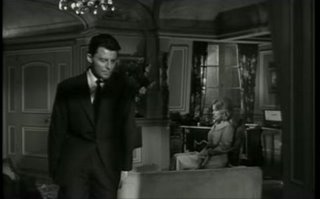
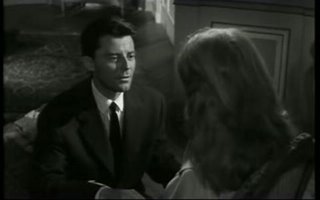
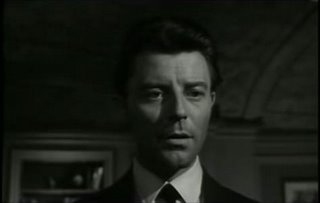
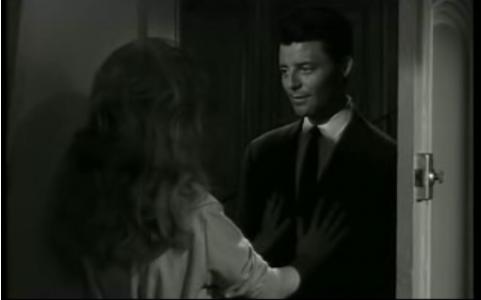
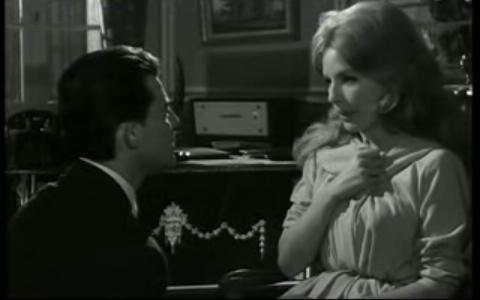
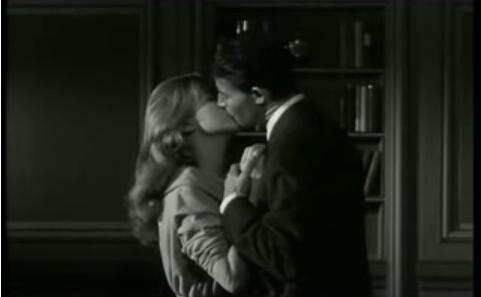
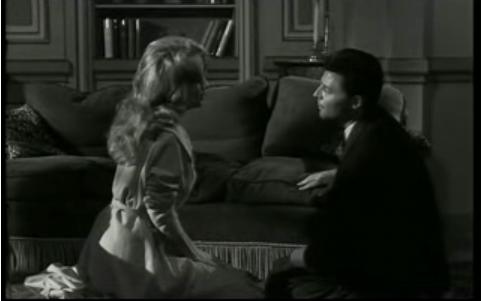
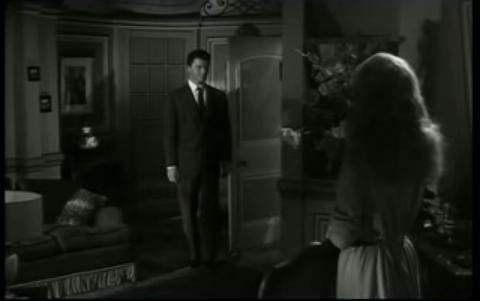
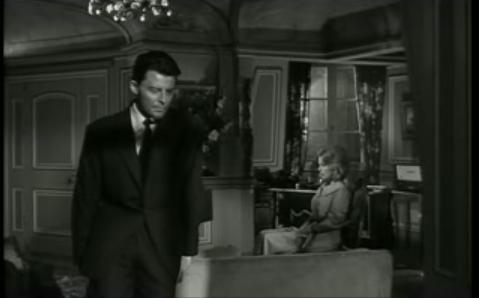
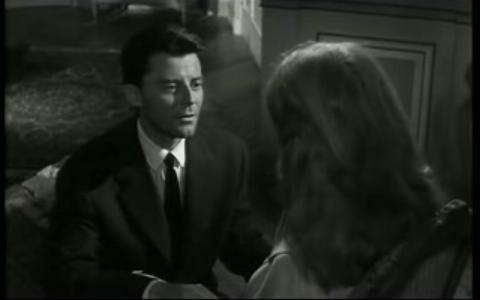
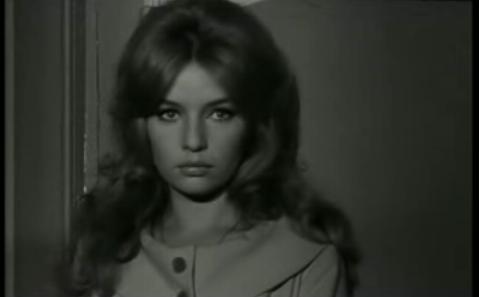
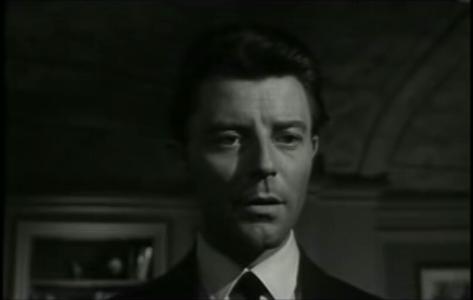
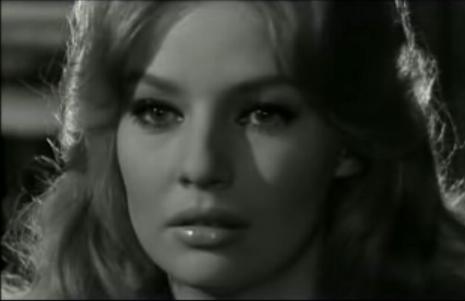
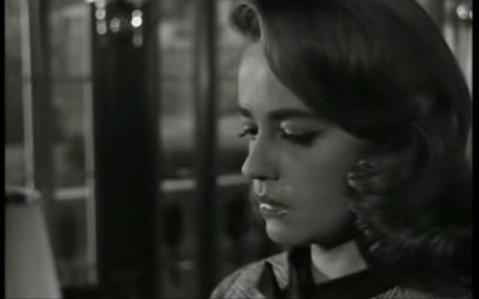
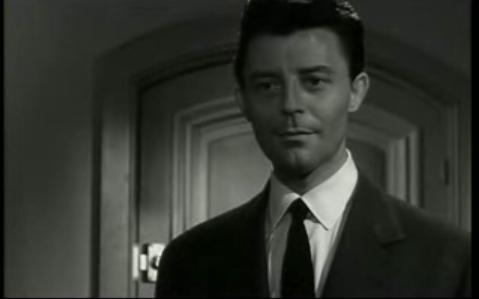
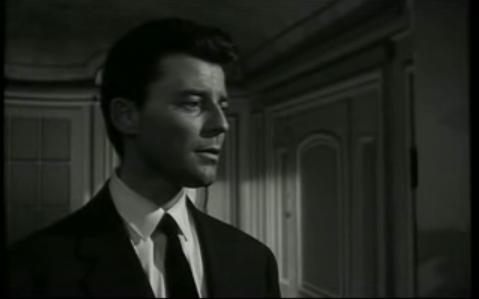
The simple scenes in Les Liaisons dangereuses are exactly where Vadim establishes his talent. His compositions and camera movements have great natural beauty, and also preserve a balance between subjectivity and an objective, environmental perspective. The now-familiar source material (I haven’t read Laclos’ novel, but I feel as if I have after seeing at least four adaptations of it) opens an intriguing gap between the malevolence of the protagonists and their more conventional sentimental aspirations, and Vadim and his writer Roger Vailland are intuitive enough to enhance the emotional gravity that accompanies the characters’ nasty gamesmanship. The best example of this approach is the stunning scene in which Valmont (Gérard Philipe) presses his courtship of the chaste Marianne (Annette Vadim) while they walk amid snowy mountains at a winter resort. Valmont’s seduction strategy, described in voiceover, is to tell Marianne the truth about his life of depravity; and so the scene plays with a built-in dual perspective, according to which Valmont makes both a calculating power play and a naked confession to a woman who is already more than just a victim to him. Vadim plays the scene for maximum solemnity, letting Valmont’s words resonate in the majestic spaces that shift behind the characters, and keeping his camera a little low and far enough away from the couple that their figures never completely eclipse the elemental environment.

Throughout the film, Vadim’s innate seriousness makes it possible for him to give the cruelty of the subject matter its full weight, neither softening it (cf. the Forman/Carrière and Kumble versions of the story) nor implicating himself in it (cf. the Frears/Hampton version). This is not to deny a certain number of missteps, mostly near the ending, possibly attributable to internal or external censorship. One can see Vadim as divided between a fruitful iconoclasm and a more conventional or conformist tendency. (If film criticism has tended to regard Vadim as the cinema’s answer to Hugh Hefner…well, Hefner too is half revolutionary and half conformist, and his career declined in the same precipitous fashion.)

Before I insert images into this blog for the first time, I’m going to make a tentative attempt to generalize some of the above comments about composition. When I watch a movie and think, “These images are intrinsically beautiful – this director really knows how to compose,” and then try to analyze the visual style, I often conclude that the compositions are balanced between two functions: showing the figure in the foreground, and showing the world. The balance is always managed in such a way that the shot can still function in the mind of the viewer as a depiction of the foreground figure; and yet the room or landscape is presented with some spatial integrity.

And every time I watch a movie and think, “These images are dull and conventional,” I conclude upon further analysis that the compositions are framed as if they are trying to present only one object, or one idea, and that the image reduces in my mind to a concept. Closeups are composed to show the person and not much else; longer shots are far enough back that the relation of the object or person to the surroundings seems to motivate the composition. I don’t necessarily think that shots that fit this description are a liability, but they miss out on intrinsic beauty, because they suggest a concept too strongly. In some cases shots like these gain value from being part of a larger artistic structure.

I was first put onto this train of thought when I attended another circumstantial double bill at MOMA of Mankiewicz’s House of Strangers and Fregonese’s Black Tuesday. I felt as the films had utterly different visual agendas: it seemed to me that every shot in the Mankiewicz film had a single concept behind it, and could be translated into words without loss; and that every shot in the Fregonese film was a picture of the world, with its complexity preserved.

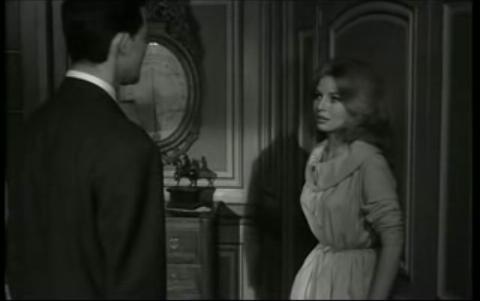
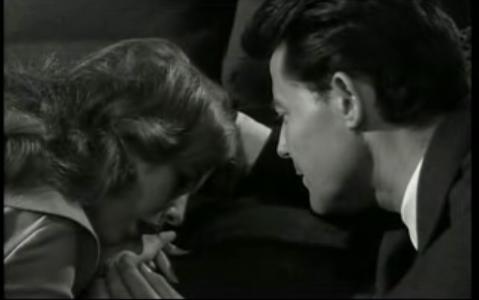
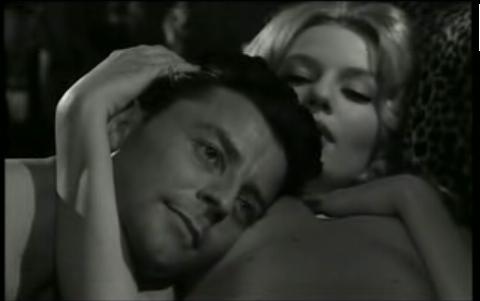
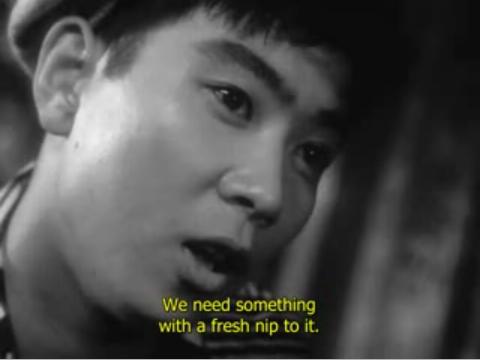
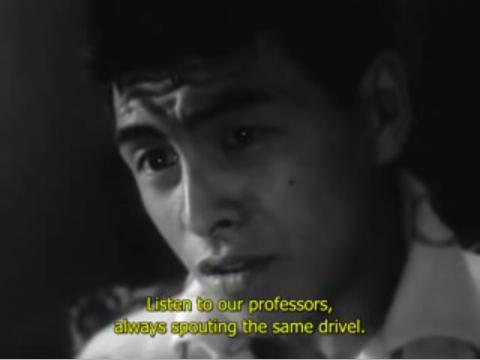
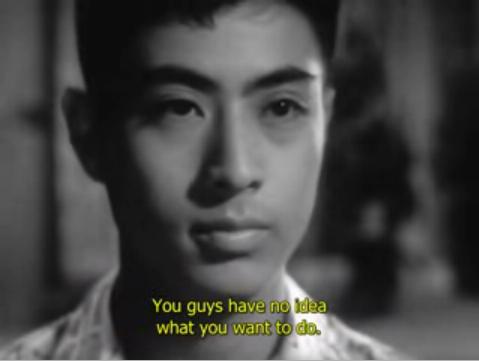
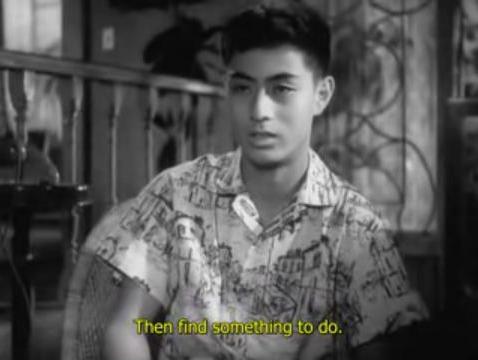
I don’t have DVDs of Kurutta kajitsu or Les Liaisons dangereuses, so I’ll compare still images from the films that I found on YouTube. From the very limited selection of clips available, I chose two fairly unremarkable interior scenes: a teen party from Kurutta kajitsu in which the representatives of reckless youth state their credo; and the culmination of Valmont’s attempt to seduce Marianne in Les Liaisons dangereuses. The scenes have different emotional trajectories (not to mention different aspect ratios) and therefore don’t compare perfectly, but they do give a sense of Nakahira and Vadim’s compositional tendencies.

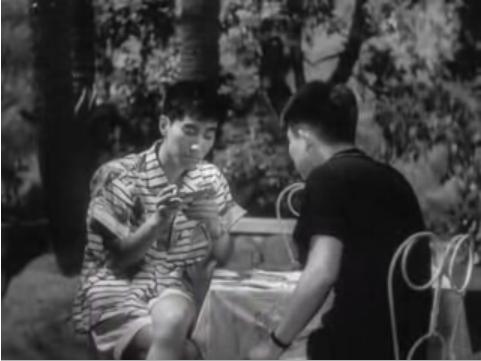
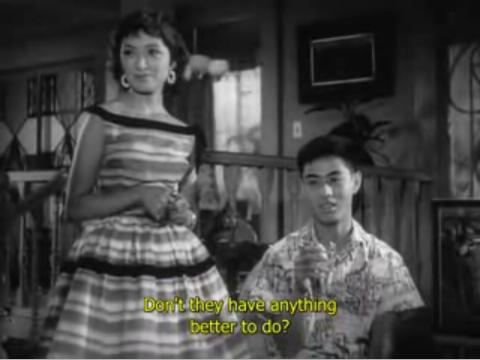
Let’s compare two-shots first. The Nakahira scene is heavy on closeups, but it contains a few two-shots:
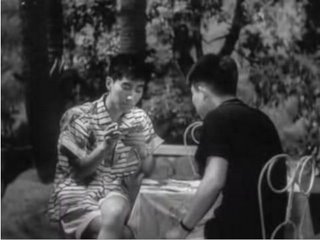
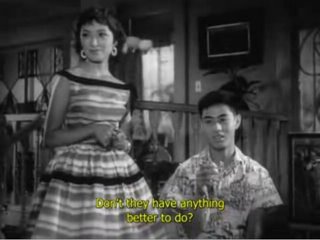
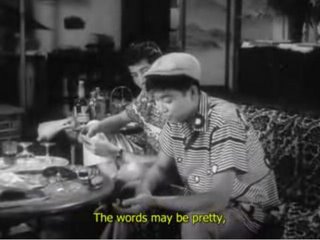

The lack of compositional tension in the shots can partly be chalked up to the emotionally neutral content of the scene: none of the characters in these two-shots have a strong personal relationship to each other. Nonetheless, the layout of these shots has a cerebral quality to me: the two figures in the frame are just large enough that the frame seems to be about them and little else. The background is visible in the shots, and even has some visual appeal in the second shot; but for me the size of the people in the frame sends a signal that the background isn’t motivating the placement of the camera.

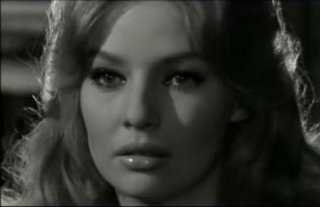
The Vadim clip is longer, so it provides more varied examples. And the emotional tension between Valmont and Marianne is at a high point, which to some extent mandates additional diagonal tension. Here are a few two-shots in this scene that are relatively free of diagonal tension, and therefore compare better to Nakahira’s two-shots:
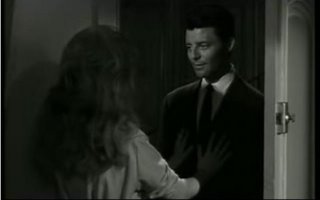
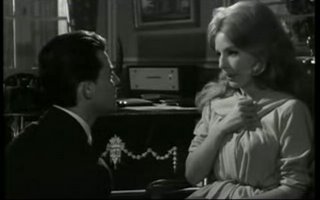
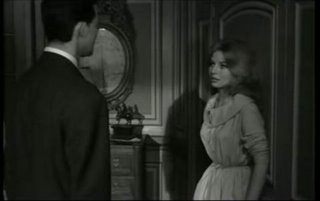
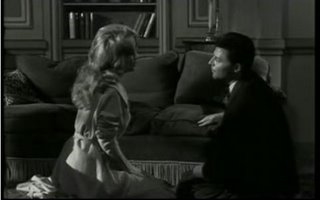

Allowing for the wider aspect ratio that Vadim uses, and also for Vadim’s use of deep focus, these shots aren’t wildly different from Nakahira’s. (The deep focus is, of course, not irrelevant to this discussion: it’s certainly an invitation to experience the characters as part of the environment. I don’t know much about Vadim’s director of photography here, Marcel Grignon. He seems to have had a long career in the European film industry, but I recognize only a few of his credits, principally Clement’s Paris brûle-t-il? and Borowczyk’s La Bête. He worked with Vadim once again, in 1963 on Le Vice et la vertu.) I perceive a greater tendency in Vadim to arrange his actors to create a sort of human terrain, a landscape with perspective and contour.

Other two-shots in the scene make greater use of distance and diagonality:
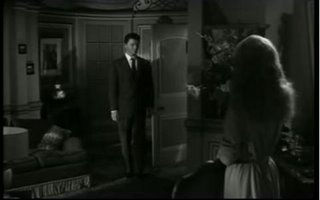


Here we see an interest in the environment that doesn’t have a parallel in the Nakahira scene. The deep focus in these shots is clearly part of a plan to photograph the texture and the space in the room, while configuring the actors in dramatic opposition to each other. There is very little in the story that draws our attention to the setting: Vadim could easily have conceived the scene as an abstract personal confrontation, but he seems to think naturally in terms of topography.

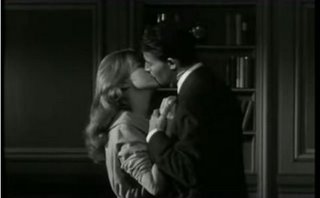
Finally, a few closer two-shots drive home the idea of actors as terrain:
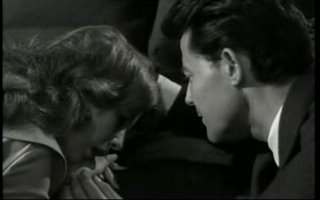


There is not much in the way of background in these shots, but the people are invested with spatial qualities of their own. I often thought of mid-period Antonioni when watching Les Liaisons dangereuses; it didn’t occur to me until afterwards that the film was released nine months before L’avventura, the film that popularized Antonioni’s wide-screen compositional style.

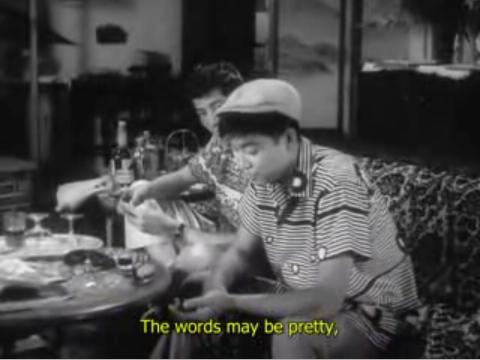
Now for one-shots. The scene I’ve chosen from Kurutta kajitsu centers on a Soviet-inspired montage sequence that cuts among a number of tight closeups, usually with tilted compositions:
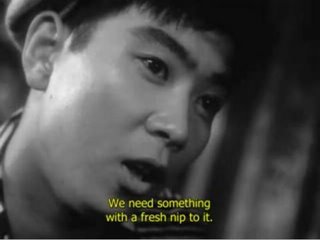
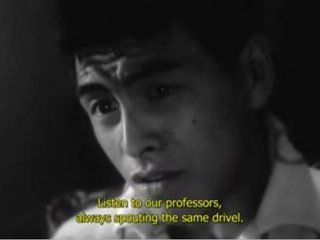
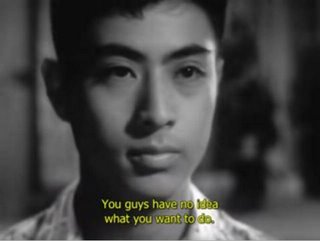

The composition that isn’t tilted is the closeup of the straight-arrow brother, whereas the tilted closeups go to the “taiyozoku.” This correspondence between composition and characterization is way too blatant to have any resonance for me.

The scene contains a few one-shots that are more conventional:
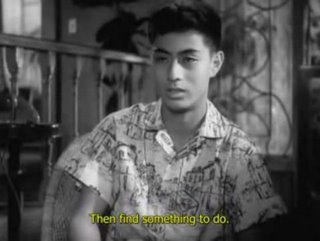

Again, Nakahira frames simply, with no apparent intention other than to show the actor. There is some visual tension in the background with the wooden railing; the direct framing of the boy again discourages me from registering him in his environmental context.

Vadim’s simplest one-shots aren’t much more complicated:
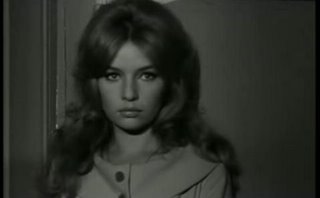


Most of the added environmental presence can be chalked up to the wider aspect ratio and the use of deep focus. Often, however, Vadim clearly shows a desire to situate the characters amid their decor, even with the limited amount of screen acreage available to show background in one-shots:
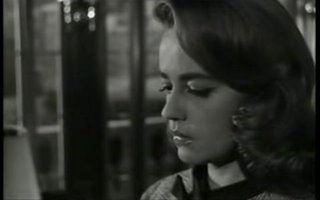
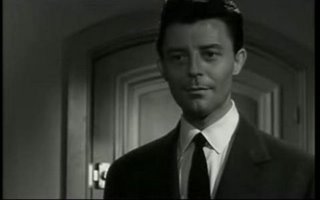
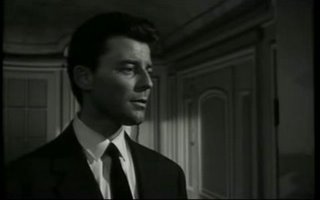
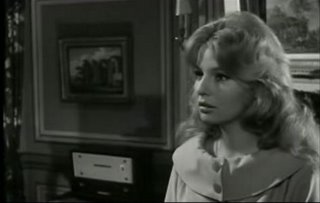

The wider aspect ratio gives Vadim greater opportunity to place actors off-center and highlight the décor, Antonioni-style.

As with the two-shots cited earlier, some of the one-shots strongly suggest the topographical qualities of the bodies of the actors:
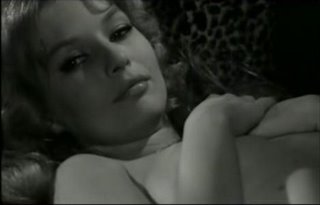

At one point, Vadim creates an off-center composition around Marianne, then moves Valmont into the frame for a more massed, topographical effect. Practically the same framing serves both halves of the shot, which suggests that Vadim’s compositions are friendly to the absence of the actors as well as their presence.


I haven’t seen Vadim’s 1957 Sait-on jamais... (No Sun in Venice), but it's often cited as one of Vadim's best (Godard reviewed it favorably in Cahiers), and it screens at MOMA in the Jazz Score series on Monday, June 16 at 6 pm and Wednesday, June 18 at 6:45 pm.

Labels: ,

Darling

A few weeks ago I took a chance on Swedish director Johan Kling's Darling when it screened at Scandinavia House, because the trailer looked interesting. I loved the movie, and wrote a short review that's up at the Auteurs' Notebook. As far as I can tell, Darling is available only on Region 2 DVD with no English subtitles - but I wouldn't be surprised if Kling has his day soon.

Labels:

Tuesday, May 27, 2008

Ballast: BAM, May 31, 2008

Lance Hammer’s American art film Ballast, which premiered at Sundance this year, gets a NYC theatrical release from IFC Films on August 29. But you can preview it this Saturday, August 31 at 9 pm when it screens in BAM’s Sundance series. A quiet fable of despair and salvation among the impoverished residents of the Mississippi Delta, Ballast is visually overwhelming from its first shot: the camera work is simple and direct, but the natural light of the overcast delta gives Hammer’s widescreen, horizon-line compositions a palpable realism. (Is conventional film lighting necessary at all? Seems to me that most of the really dazzling effects I see are the result of imperfections that point up the limitations of the photographic image.) The first movement of Ballast, jumping mysteriously between solid blocks of image and sound that allude to the story rather than narrate it, is sublime: a documentary stalked by a horror film, a subtle infusion of naturalism with the uncanny. If the film ultimately settles into a more conventional form of storytelling, it retains an exciting connection with the intractable personalities of its non-professional performers and the darkling barrenness of the terrain. The proof of Hammer’s artistic intuition is that he hinges the story’s climax on a magical event that only a committed realist could get away with; the proof of his artistic commitment is that he lets the film’s bleak setting and ominous imagery have their way with the potentially heartwarming ending.

Labels: ,

Wednesday, May 7, 2008

The Tracey Fragments: Village East, starting Friday, May 9, 2008

I already blogged slightly about Bruce McDonald's The Tracey Fragments. Anticipating its limited theatrical release in NYC on May 9, I blogged about it in more detail at The Auteurs' Notebook.

Labels: ,

Tuesday, May 6, 2008

60s Godard via Le Petit Soldat

I don’t love Godard’s Le Petit soldat - I don’t know why: I want to, and feel as if I should – but I’m fascinated by it. It’s the closest Godard has come to being a pure stylist: one can almost imagine that he was a director for hire on a relatively commercial project, and that he turned in work which didn’t completely alienate his producers. For this reason, it lays bare aspects of Godard’s approach that, though always present, are less conspicuous in his other films because of the sheer density of creativity. I’m far from a Godard expert, but I’ll put in my two cents about how his 60s films work for me.

Topic #1: How Much Can You Undermine a Story and Still Have It Function As a Story? The torture scenes in Le Petit soldat, which are the structural center of the movie, get a lot more screen time and attention than Godard usually gives to structural centers. This is probably why Soldat feels more mainstream than other Godard works.

But one couldn’t mistake the scenes for the work of any other director. Immediately one notes that Godard wants to flatten the tone by removing, not just emotional highs and lows, but even references to them. Subor’s voiceover does a lot of the flattening: he discusses his torture in cool, analytical terms, mentioning pain only as a catalyst for his thought processes. And the images of torture inflict on the audience few signs of Subor’s discomfort. I believe that we hear no cries and see no anguished facial expressions.

We see this flattening again at the film’s other emotional high point, the ending. I won’t spoil it, but exactly the same techniques are used: the voiceover is tipped in the direction of detachment, and we aren’t shown grief or pain. However, the ending is unlike the torture scenes in that Godard shortens it almost to the vanishing point with ellipsis and truncation.

This second example is closer to Godard’s usual handling of narrative in the 60s period. It’s a fairly general practice for him to skip quickly and elliptically over scenes that would be narrative high points in a mainstream production. In addition to the ellipsis, the scenes are flattened emotionally as well. Far from feeling that big moments are being pulled away from us by the ellipsis, we often can’t even spot the climaxes as climaxes because of the flatness. Pierrot le fou is a good example of a Godard story that is potentially a thriller, but that has been systematically deprived of all narrative urgency, so that the progression of the action story is little more than facts thrown at the audience in passing.

Of course, Godard doesn’t always move quickly. He can dawdle with the best of his art-house contemporaries. But the storytelling moments that demand deliberation and emphasis in commercial cinema are usually weakened in his films.

Because Godard uncharacteristically takes his time during the Soldat torture scenes, the flattening of storytelling affect is easier to spot.

Topic #2: Men Are a Lot Like Cameras When They Look at Women. Soldat slows to a contemplative crawl during the scene in which Subor takes photos of Anna Karina. This fascination with women was well-established even at this early stage of Godard’s career. (The short that played with Soldat in Film Forum’s "Godard’s 60s" retrospective, 1958’s Charlotte et son Jules, is suspended in such a moment of contemplation from beginning to end.) Typically in this period, scenes devoted to visual contemplation of the female lead are so protracted and laden with emphasis that they bend the film’s meaning, giving centrality to a love interest who might play a marginal role in a commercial version of the same story.

Godard's fascination with women is often presented explicitly as a gender gap. The male protagonist expresses misgivings and insecurity about, as well as desire for, the woman, either in dialogue or in voiceover. Whereas the woman has a more centered demeanor: she is carefree, content, not especially focused, and enjoying her status as spectacle. If the man is harsh to the woman, it generally does not affect her mood. The man usually raises questions about what is going on inside the mind of the woman, questions that force the conclusion that the woman cannot be known, either to the man or the camera.

It is not lost on Godard that the audience is staring at the woman exactly as the male lead does. And it often happens that the woman will turn her attention directly to the camera instead of to the man, with the same flirtatious insouciance. The reflexivity that stalks every frame of every Godard film seems to take on a special gravity here: filmmaking may be a game, but the fascination and the mystery of the woman are not.

One can judge this fascination in different ways. The word "essentialism," not a compliment in gender studies, comes to mind. And Godard’s fascination with women often seems to be just a hair’s breadth away from anger and hostility. But I confess that my love of his films is closely associated with his fixation on the otherness of women, and the films that move away from this fixation usually engage me less. Godard’s love/hate gaze across the gender gap is the place where the rubber meets the road, where his pleasure in filmmaking most sympathetically makes contact with his engagement with life. The maleness of his 60s stance, the lack of distinction between women and what women make him feel, would be a handicap if he were a philosopher. But an artist needs an angle, a gimmick, an entry point to human experience.

Labels:

Sunday, April 27, 2008

Charly: Tribeca, April 27 and May 1 and 3, 2008

After her debut Demi-tarif, and even after the first 30 minutes of her second feature Charly, it wasn't clear to me that Isild Le Besco was going to find a way to integrate the sensual immediacy of her film style into a larger structure. But I think everything is going to be all right with her. As the film's young, enigmatic protagonist (Kolia Litscher) is adopted by the eponymous trailer prostitute (the excellent Julie-Marie Parmentier), Le Besco's fanciful, free-floating universe is invaded by psychology and fairy tale at the same time. To watch the semi-literate boy and his OCD-afflicted hostess get excited about an impromptu reading of Wedekind's Spring Awakening is to realize how many layers of meaning Le Besco has been sneaking in while we were listening to the tiny shocks of ambience change on each cut. After three days and nights, the trailer idyll culminates in a startlingly beautiful sex scene and the emergence of the boy protagonist as the author of his own fiction. Charly screens three more times at Tribeca: on Sunday, April 27 at 9:45 pm at the 19th St. East; on Thursday, May 1 at 10:15 pm at the Village East; and on Saturday, May 3 at 5:30 pm at the Village VII.

Labels: ,

Sunday, April 20, 2008

The Paper Will Be Blue: Walter Reade, April 21, 2008

If you haven't made plans yet for tomorrow (and if you're not headed to BAM to see Tomu Uchida's rare and well-regarded Twilight Saloon), I recommend Radu Muntean's The Paper Will Be Blue, screening in the Walter Reade's Romanian film series at 6 pm on Monday, April 21. A 2006 Locarno premiere, Paper shares a subject - the Romanian people's moral confusion as the Ceauşescu regime teetered in December 1989 - with Corneliu Porumboiu's 12:08 East of Bucharest, but is closer in style and attitude to Cristi Puiu's superb The Death of Mr. Lazarescu. (Paper and Lazarescu share a writer, Razvan Radulescu, whom I'll be looking out for from now on.) Like Lazarescu, Paper racks up sharp observations of a large number of characters in a shifting geography, but does not use many closeups or focus on individual character development. After a stunning opening that shows off Muntean's skill in deploying the signifiers of documentary, the film perhaps takes on a bit of a static quality, not quite attaining the subterranean mythological development that Lazarescu's subject matter provides. But the film never loses its intelligence and its balance between satire and sympathy. Maybe there really is a new Romanian film movement after all....

Labels: ,